
Trump Accounts: What They’re Actually For
Open one. Take the $1,000. Then think hard before you put in another dollar.
That's the whole recommendation, and if you stop reading here you'll have gotten the important part. What follows is the reasoning, which matters more than the conclusion depending on your goals.
Most of the coverage since the July launch has described what these accounts are without answering the only question a parent actually has: where these dollars rank against other options for your kids’ savings.
The five things that matter
Trump Accounts went live on July 4, 2026. Here's the short version:
The $1,000 is real, and it's limited. Children born between January 1st, 2025 and December 31st, 2028 are eligible for a one-time government contribution. Outside that birth window, no seed money, though a child under 18 can still have an account.
You can add up to $5,000 a year, in after-tax dollars. That limit begins adjusting for inflation in 2028.
Your employer might contribute. Employers can put in up to $2,500 per child, which counts toward the same $5,000 cap.
At 18, it becomes a traditional IRA and your child takes control of it.
The investment is fixed, and cheap. Contributions go into broad U.S. equity index funds with an expense ratio capped at 0.10%.
The Important Tax Details
The tax treatment is layered, and the layers behave differently.
The money you contribute goes in after-tax and that basis comes back out tax-free. The earnings on those contributions do not. Those are taxed as ordinary income when withdrawn. The government's $1,000, along with any employer or charitable contributions, went in pre-tax and is fully taxable on the way out.
Then there's timing. Distributions are generally off-limits until after the year your child turns 18 in most cases. From there, standard traditional IRA rules apply: penalty-free at 59½, with a 10% penalty before that unless an exception applies. Like traditional IRA’s there are exceptions that avoid the 10% penalty with the most notable being higher education expenses and first-time home purchase (up to $10,000) but there are better funds to access for these purposes.
The bottom line is that this is a retirement account with your child's name on it.
How it Stacks Up
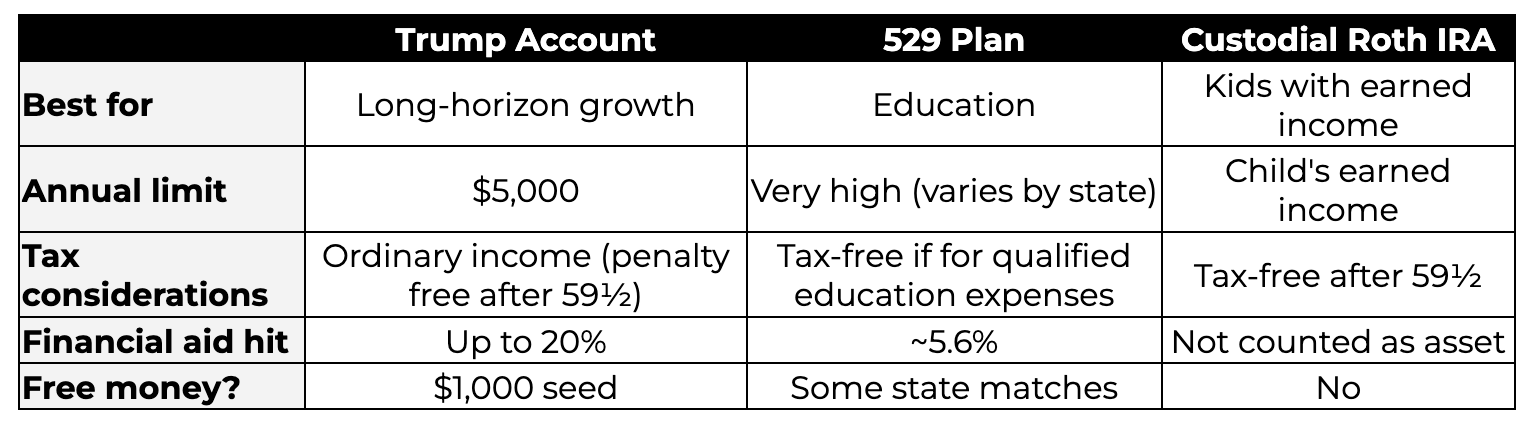
Two points are worth a closer look:
Tax considerations. Compare Trump accounts not just to a 529 but to a plain brokerage account. Long-term gains and qualified dividends in a brokerage account get preferential tax treatment (long-term capital gains vs ordinary tax rates). Trump Account withdrawals don't. Over a multi-decade horizon that gap compounds against you, which is the trade-off you accept in exchange for tax-deferred growth along the way.
Financial aid. Consider how different accounts will impact your child’s ability to get financial aid. A Trump Account is a student-owned asset, assessed at up to 20% in the Student Aid Index formula, which is a common metric schools use to assess financial aid eligibility. A parent-owned 529 is assessed at roughly 5.6%. If aid is anywhere in your picture, funding a Trump Account for education costs you twice: once on taxes, once on eligibility.’’
What We’d Actually Do
Claim the $1,000. It's free, it's invested in a low-cost index fund, and there's no downside to a funded account sitting there. That could be worth $4,000 by the time your child is 18 and $100,000 by the time they are 60.
Check whether your employer contributes. Up to $2,500 you didn't have to earn is worth five minutes of asking.
Fund the 529 for education goals. Tax-free qualified withdrawals, better aid treatment, far higher limits. For college, it isn't close.
Then consider additional Trump Account dollars if your child's retirement is genuinely a goal you want to fund.
If your child has earned income, a custodial Roth beats all of it. Same long horizon, tax-free growth, no financial aid haircut.
Most families reasonably stop after step three.
Three mistakes we’re already seeing:
Viewing it as a college account. The name doesn't say education and neither do the rules. Money you'll need at 18 shouldn't sit in a vehicle designed to be untouchable until 59½.
Funding it without a withdrawal plan. Getting money in is easy. Getting it out is where this account punishes people who don’t plan ahead. Nothing comes out until your child turns 18, and anything before 59½ becomes costly to your child. Decide what this money is for before the first deposit and use the account as an opportunity to bring your child into personal finance discussions early.
Skipping the basics. Funding a child's Trump account while your own emergency fund is thin, your 401(k) match is unclaimed, or before optimizing their 529 accounts can leave your portfolio off balance and open you and your child to unnecessary risks. Focus on the basics to give yourself a solid base to then have flexibility down the road.
Our Takeaway
A Trump Account is a decent retirement account for your child with a real head start attached to it. It is not a college fund, it is not a tax shelter, and it is not a reason to redirect dollars from anything already working.
Take the $1,000. Take the employer money if it's there. Then go back to whatever plan you had before July.